When to hire a QA team vs outsource testing (a practical guide)
When to hire a QA team vs outsource software testing: what each really costs, when in-house makes sense, when to outsource, and the hybrid most teams should use.
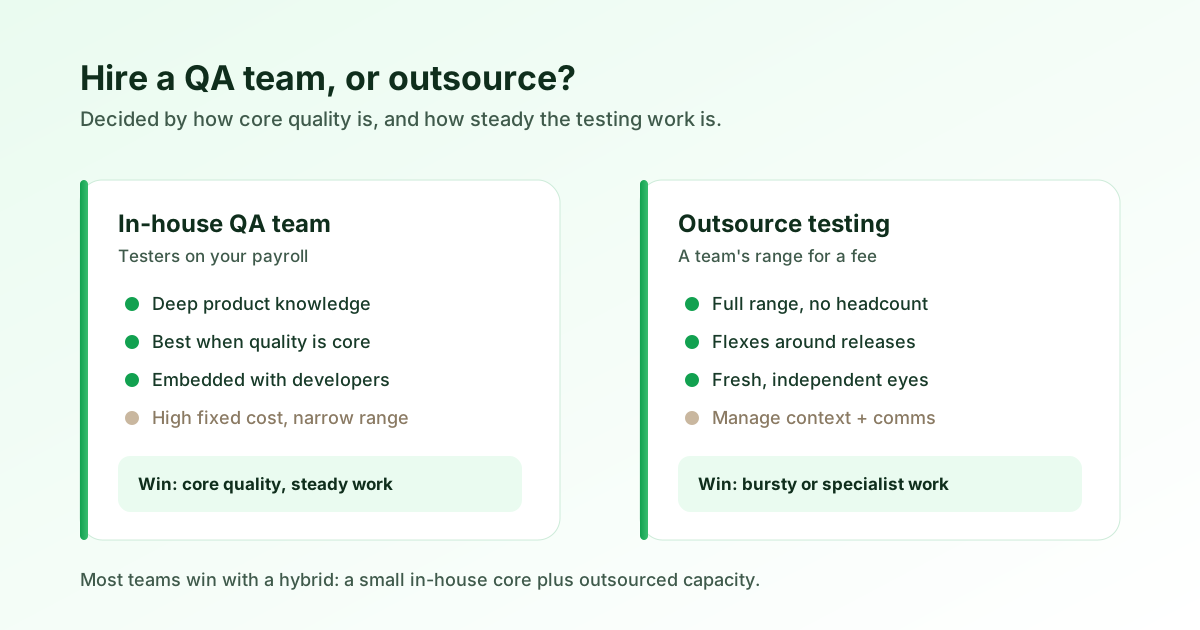
Whether to hire a QA team or outsource testing comes down to how core quality is to your product and how much steady testing work you actually have. Build an in-house QA team when quality is central, releases are frequent, and there is enough full-time work to keep testers busy. Outsource when testing comes in bursts, you need capacity or specialist skills fast, or you want an independent set of eyes. For most teams the honest answer is a hybrid: a small in-house core that owns quality, plus outsourced capacity and automation for the heavy, repetitive work. The costly mistakes are hiring a full-time team for part-time work, or outsourcing something so core it should stay close.
This guide covers what each model really costs, when each wins, where test automation fits, and how to run the hybrid that suits most software teams.
Key takeaways
- The decision hinges on how core quality is and how steady the testing work is.
- Outsourcing is usually cheaper and faster until testing is a daily, full-time need.
- Build in-house when quality is core, releases are frequent, and work is steady.
- Automate repetitive regression checks; keep humans for exploratory and judgement-heavy testing.
- Most teams win with a hybrid: a small in-house core plus outsourced capacity and automation.
First, be clear on what testing you need
Before choosing a model, define the work, because “testing” spans a wide range. There is functional testing (does it do what it should), regression testing (did a change break something that worked), exploratory testing (poking at it like a real user to find the unexpected), usability, performance, security, and test automation (writing code that runs checks for you). Some of this is repetitive and ideal to automate; some needs human curiosity and judgement. Some you need constantly; some only around releases.
The right model depends entirely on which of these you need and how often. A product shipping daily with a large surface area has very different needs from one that releases every few weeks. Getting clear on the actual work is the foundation of the decision, and it is the same diagnosis that drives our product QA work: test what matters, in the way that fits how you build.
What in-house QA really costs
The headline cost of an in-house QA team is salaries, but that is only part of it. The true cost includes fully loaded salaries, tooling and test-environment costs, and the management time to lead the function well. There is also the range problem: quality spans manual testing, automation engineering, performance and security, and one or two hires rarely cover all of it, so you either accept gaps or keep hiring.
In-house genuinely wins when quality is core and the work is steady. When you ship frequently and testing is continuous, you want testers who know your product deeply, sit with your developers, and build up institutional knowledge of where the bugs hide. That closeness and accumulated context is real value that a distant vendor cannot easily match. Where in-house loses is when you hire full-time testers for work that only fills part of their week, paying full price for part-time value, which is exactly the trap to avoid. The same build-versus-buy logic applies here as it does to data analytics and to software itself.
What outsourcing testing really costs
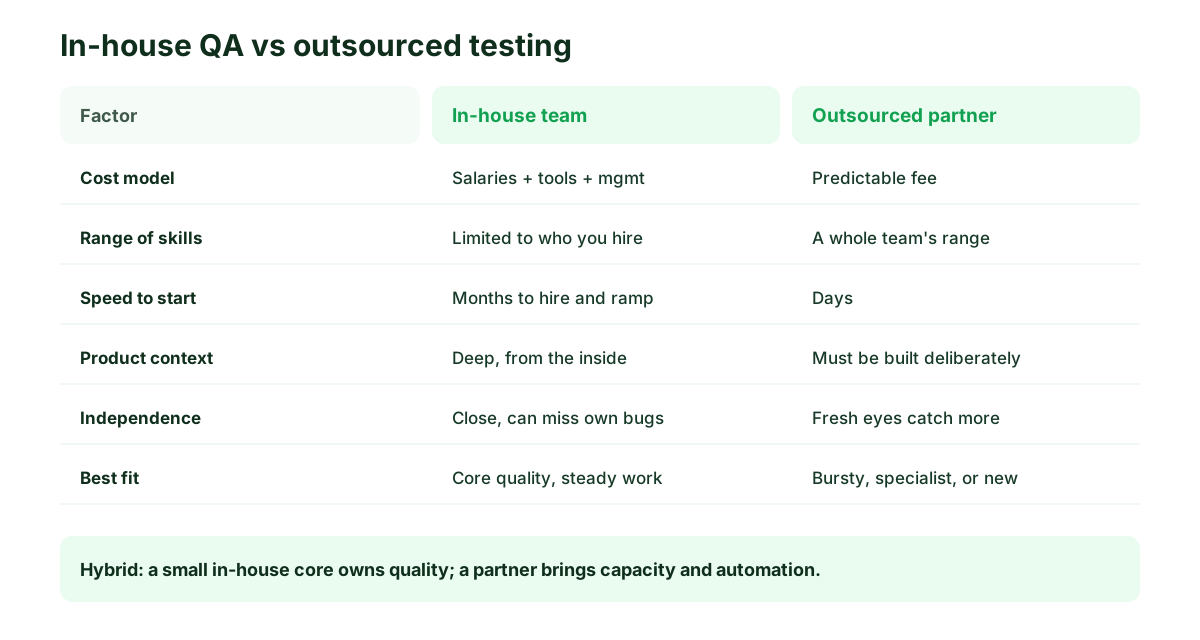
Outsourcing replaces salaries and tooling with a predictable fee, and for that fee you get a team’s range of testing skills rather than one or two people’s. A good testing partner brings manual testers, automation engineers and specialists as one unit, and can scale up around a big release and down between them, which is hard to do with fixed headcount. You also get speed: an established partner can start testing in days, not the months it takes to recruit and onboard.
There are two more underrated benefits. First, independence: a fresh, outside team often catches bugs your own developers, too close to the product, no longer see. Second, flexibility: you pay for testing when you need it, not a fixed cost that sits idle in quiet periods. The trade-offs are product context (an outside team starts knowing less about your product) and communication (especially across time zones), both real and both manageable, as covered below. The economics are simple: outsourcing is cheaper and faster until your testing work becomes large and daily enough that a dedicated in-house team stays fully occupied.
Where test automation fits (either way)
Whichever model you choose, test automation deserves its own decision, because it changes the cost of quality dramatically. The principle is to automate the stable, repetitive checks you run constantly, above all regression tests, so that every release is automatically verified against everything that worked before, freeing people from re-testing the same things by hand. Automation pays back many times over on anything you run repeatedly.
What you should not try to automate away is human testing where judgement matters: exploratory testing, usability, and the messy edge cases real users hit. The widely referenced test pyramid captures the balance: lots of fast automated checks at the base, fewer slow manual ones at the top. Guidance from bodies like the ISTQB similarly stresses that automation complements skilled human testing rather than replacing it. Get this balance right and both in-house and outsourced models get far more effective, because people spend their time on what only people can catch.
When to build an in-house QA team
Choose in-house when the answers point that way:
- Quality is core to your product. If a bug directly damages your reputation or revenue, that capability belongs close.
- You release frequently. Continuous shipping needs continuous testing embedded with your developers.
- You have steady, full-time work. Enough testing to keep dedicated people genuinely busy.
- You can manage it well. Someone who can hire, direct and grow a QA function, not just add headcount.
- Deep product knowledge compounds. When value comes from testers knowing your product inside out over time.
If most of these hold, build. The cost is justified because quality is central and continuously exercised.
When to outsource testing
Choose outsourcing when the mirror image is true:
- Testing comes in bursts. Heavy around releases, quiet between, so fixed headcount would sit idle.
- You need capacity or specialists fast. A big release, a new platform, or security and performance skills you lack.
- You want independent eyes. A fresh team to catch what your own developers have stopped seeing.
- You want range without headcount. A whole team’s skills for a predictable fee.
For many teams, especially smaller ones and those without daily, full-time testing needs, this describes reality better than the in-house list, which is why outsourcing or a hybrid is the common answer.
The hybrid most teams should use
As with most build-versus-buy questions, the option that usually wins is the hybrid. Keep a small in-house core, even one QA lead, who owns quality standards, knows the product deeply, and decides what gets tested and how. Send the heavy, scalable work, large regression cycles, automation build-out, specialist performance and security testing, and release-time surges, to an outsourced partner. You get deep product ownership and a team’s range and flexibility, without carrying a large fixed QA payroll.
This is the model we build around in our product QA work: an owner of quality on your side, with the capacity and automation handled by us, and everything, test cases, automation, documentation, kept in your accounts so you are never locked in. It gives a small team enterprise-grade quality coverage at a sustainable cost, and it scales cleanly as you grow, because the in-house core stays small while outsourced capacity flexes with your release schedule.
Managing the risks of outsourced QA
Outsourced testing fails in predictable ways, and each is avoidable. The first risk is lost product context: an outside team that never learns your product tests the letter, not the spirit. Fix it by choosing a partner who invests in understanding your product and users, and by keeping them embedded, not at arm’s length. The second is inconsistent quality: manage it with clear standards, defined test coverage, and an in-house owner who holds the bar. The third is communication, especially across time zones: fix it with overlap hours, clear written test reports with reproduction steps, and shared tooling. And always keep your test cases, automation and documentation in your own accounts, so the knowledge is yours and you can change partners or bring work in-house whenever you choose. Handle these deliberately and outsourced QA behaves like an extension of your team rather than a distant vendor.
The real cost of skipping QA
It is worth naming what all of this is protecting against, because teams under pressure often treat testing as optional and pay for it later. The cost of a bug is not fixed; it rises sharply the further it travels. A bug caught as code is written costs almost nothing to fix. The same bug caught in testing costs a little more. Caught by a customer in production, it costs far more: emergency fixes, lost trust, churn, support load, and sometimes reputational damage that outlasts the fix. This is the well-established economics of quality, and it is exactly why testing is an investment, not an overhead.
Seen this way, the build-versus-outsource question is really about how to buy the right amount of quality assurance at the right cost, not whether to bother. A team shipping without meaningful QA is not saving money; it is deferring a larger, less predictable cost onto its future self and its customers. Whichever model you choose, the point is that shipping tested software reliably is cheaper over any real time horizon than shipping fast and firefighting.
A quick decision checklist
Run your situation through five questions. Is quality core to your product and reputation? Do you release frequently enough to need continuous testing? Is there enough steady work to keep dedicated testers busy? Do you have someone who can manage a QA function? Will the knowledge compound by living in-house? Mostly yes points to building an in-house team. Mostly no, or bursty and specialist needs, points to outsourcing. A mix, which is where most teams sit, points to the hybrid: a small in-house owner plus outsourced capacity and automation. Whatever you choose, keep your test cases and automation in your own accounts so you stay in control.
Where to start
If you are unsure whether to hire, outsource, or blend the two, start by getting clear on the actual testing work and where quality is currently slipping. Our free audit looks at your product, your release cadence and your current gaps, and tells you honestly which QA model fits and what to automate first, before you commit to a salary or a retainer. From there, our product QA work gives you a team’s testing range with quality ownership kept firmly on your side, as part of the broader Automate work that makes your product reliable as it grows.
Frequently asked questions
Hire in-house when quality is core to your product, releases are frequent, and you have steady, full-time testing work plus someone to manage it. Outsource when testing needs come in bursts, you need capacity or specialist skills fast, or you want a fresh, independent set of eyes. Many teams use a hybrid: a small in-house core plus outsourced capacity and automation.
Usually, until testing is a daily, full-time need. Outsourcing replaces salaries and tooling with a predictable fee and gives you a team's range of skills, which is cheaper per unit of work at low or bursty volume. In-house becomes cheaper only when you have enough steady work to keep dedicated testers fully occupied.
Automate the stable, repetitive checks you run on every release, especially regression tests, because they pay back many times over. Keep human testing for exploratory, usability and edge-case work where judgement matters. The goal is not to automate everything, but to automate the repetitive parts so people focus on what only people can catch.
The main risks are losing product context, inconsistent quality, and slow communication across time zones. You reduce them by choosing a partner who learns your product deeply, keeping test documentation and automation in your own accounts, and treating them as an embedded part of the team rather than a distant vendor.
Want this done for you?
Yovance is an AI growth and automation studio. We can put this into practice for your business.