How to build a content engine without burning out your team
How to build a content engine: a repeatable system for consistent, useful content that fuels search, AI search and trust, without exhausting your small team.
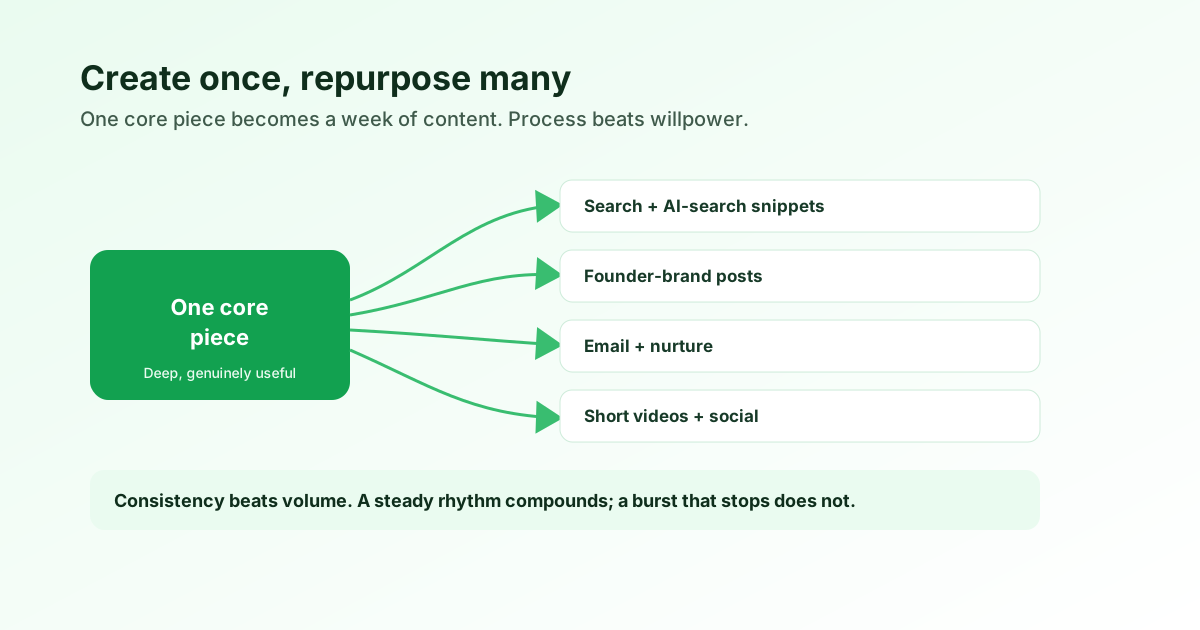
To build a content engine without burning out your team, stop treating every piece as a fresh act of inspiration and build a repeatable system instead: choose topics deliberately, create one strong core piece at a time, repurpose each into many smaller pieces across channels, and publish on a steady, realistic rhythm. The businesses that produce content consistently are almost never the most creative or the biggest; they are the ones with a process that does not depend on anyone having a spare burst of energy. Consistency comes from the system, not from heroics, and that is exactly what protects your team from burning out.
This guide covers what a content engine actually is, the repeatable process behind it, how to turn one idea into many pieces, the rhythm that is sustainable, and how to run it with a small team.
Key takeaways
- A content engine is a repeatable system, not a burst of inspiration. Process beats willpower.
- Create one strong core piece, then repurpose it into many smaller pieces across channels.
- Consistency beats volume. A modest, steady cadence outperforms a big burst that stops.
- Keep the ideas and point of view in-house; the production and repurposing can be systematised.
- One content engine feeds search, AI search, social and your founder brand at once.
What a content engine actually is
Most content fails not because the ideas are bad but because the effort is not repeatable. A business posts furiously for a month, someone gets busy, and it all stops, so trust never compounds and search never rewards the inconsistency. A content engine fixes this by replacing inspiration with a system: a defined process that reliably turns your expertise into useful content, week after week, whoever is or is not feeling inspired.
The point is durability. When content runs on a system, it survives busy weeks, staff changes and low-energy days, because the process carries it rather than any one person’s motivation. That is what makes content a compounding asset instead of a stressful chore, and it is exactly what our content engine work is built to deliver. Done right, one engine feeds everything: AI search visibility, your founder brand, and social, all from the same core effort.
The repeatable process behind it
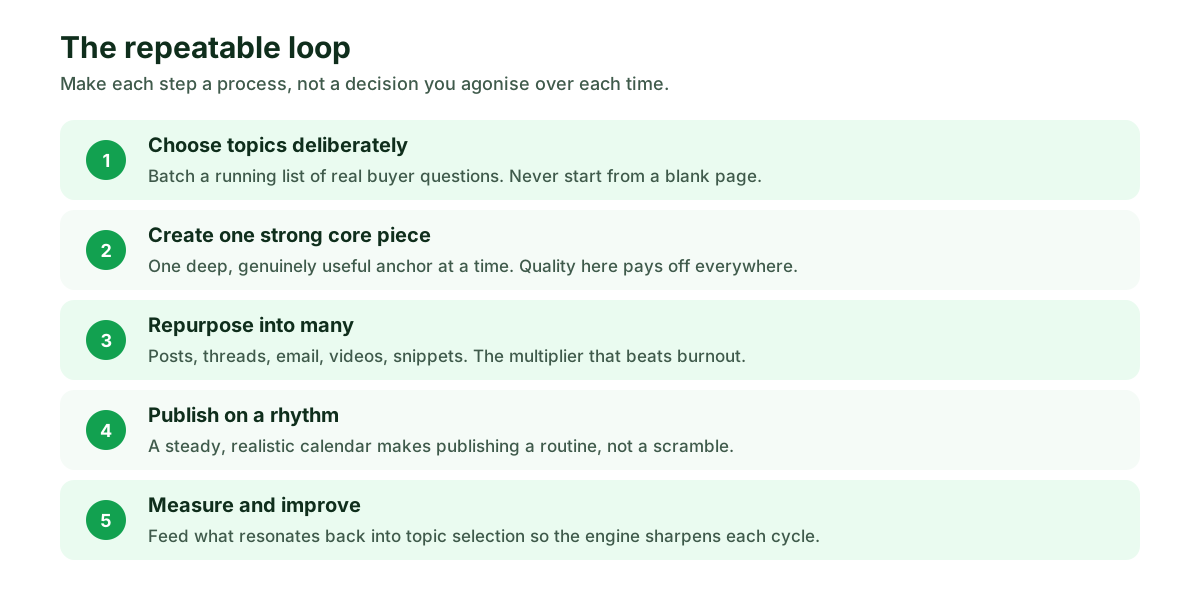
Every reliable content engine runs the same loop. Make each step a defined process, not a decision you agonise over each time.
- Choose topics deliberately. Do not start from a blank page each week. Build a running list of the real questions your buyers ask, the terms they search, and the things you can speak on with authority. Topic selection done in batches removes the hardest, most draining part: deciding what to make.
- Create one strong core piece. Instead of many shallow pieces, make one genuinely useful anchor piece at a time, a deep article, a webinar, a detailed guide, built around a topic that matters. Quality here pays off everywhere downstream.
- Repurpose into many. This is the multiplier. One core piece becomes several social posts, a founder-brand thread, an email, short videos, and answer-first snippets. You get the reach of many pieces from the effort of one.
- Publish on a rhythm. Schedule everything on a steady, realistic calendar so publishing is a routine, not a scramble. The rhythm is what makes it feel effortless over time.
- Measure and improve. Track what resonates and feed it back into topic selection, so the engine gets sharper each cycle rather than guessing forever.
The magic is in step three. Most burnout comes from trying to create fresh content for every channel separately; the engine creates once and repurposes many times.
Create once, repurpose many
The single biggest lever against burnout is repurposing, so it is worth its own section. When you write one strong article, you are not producing one piece of content, you are producing raw material for a dozen. The key points become individual social posts. A contrarian angle becomes a founder-brand post. The core argument becomes an email. Sections become short-video scripts. The direct answers become snippets built for AI search and featured results, the kind of answer-first content covered in how to rank in AI search.
This is how a small team achieves the output that looks like a much bigger one. You are not working harder; you are extracting more from each piece of thinking. Guidance from content research bodies like the Content Marketing Institute consistently finds that the most effective content programmes are built on documented processes and reuse, not on constantly starting from scratch. Once repurposing is a habit, the volume problem largely solves itself, because one good idea now fills a week of channels.
The rhythm that is sustainable
Ambition is the enemy of consistency. Businesses commit to daily everything, cannot keep it up, and quit, concluding content does not work. The fix is to choose a cadence you can genuinely sustain on your worst week, not your best. For most small teams that means something like one core piece and a handful of repurposed pieces a week, published reliably, rather than a heroic sprint that collapses.
Consistency beats volume because both search and human trust reward reliability over intensity. A steady drumbeat of useful content, sustained for a year, compounds into real authority; a brilliant burst that stops after six weeks compounds into nothing. Research on how people actually consume content, including from the Nielsen Norman Group, underscores that usefulness and clarity earn attention far more than sheer quantity, so a smaller amount of genuinely helpful content wins. Pick a rhythm you can hold, and let time do the compounding.
Running it with a small team
The fear behind all of this is that content needs a big team. It does not; it needs a clear division of labour. The scarce, irreplaceable input is the thinking, your real expertise, point of view and stories, which must come from inside the business. The rest, turning that thinking into polished, repurposed, scheduled content, is systematic work that can be templated, delegated or outsourced.
That is why the hybrid model works so well for small businesses: the founder or team supplies the raw ideas in a quick, low-effort way, a recording, a rough outline, a voice note, and a system or partner turns it into finished, repurposed content on a reliable schedule. You keep the part only you can do and offload the part that eats time. This is the same build-versus-buy logic we cover for analytics: own the judgement, systematise the production. It is how a two-person business can publish like a ten-person one without anyone burning out.
A worked example: one article, a week of content
To make the multiplier concrete, picture a single strong article, say this kind of buyer-question guide. From that one piece, a small team can produce: three or four LinkedIn posts, each taking one key point and expanding it in the founder’s voice; a short email to the list summarising the core idea with a link; two or three short-video scripts built from the most visual sections; a handful of answer-first snippets aimed at AI search and featured results; and a carousel pulling out the main steps. That is well over a dozen pieces of content across five channels, all from one afternoon of real thinking plus systematic repurposing.
Compare that to the burnout path: sitting down separately to invent a LinkedIn post, then a separate email, then a separate video idea, each from scratch, several times a week. Same output, but many times the effort and stress. The engine is not about working more; it is about never wasting a good idea on a single use. Once a team feels this difference once, they rarely go back to creating channel by channel.
Tools help, but the system matters more
People often ask which tools to use, hoping software will solve consistency for them. Tools genuinely help: a simple calendar, a scheduler, a shared doc for the topic list, and increasingly AI to speed up drafting and repurposing. But a tool without a system just gives you a tidier place to be inconsistent. The order matters: define the process first, choose the topics, create the core piece, repurpose, schedule, then pick the lightest tools that support that process. AI is especially useful for the repurposing step, turning one core piece into channel-specific drafts quickly, as long as a human keeps the voice and judgement, which is the part that earns trust. Reach for tools to remove friction from a process you already have, never as a substitute for having one, because the businesses that lean on tools without a system simply automate their inconsistency.
The mistakes that cause content burnout
Almost every content flame-out traces to a few avoidable mistakes. The first is starting from a blank page each time, which is exhausting and slow; batch your topics instead. The second is creating separately for every channel, when you should create once and repurpose. The third is over-committing to an unsustainable cadence and then feeling guilty when it slips; set a realistic rhythm from the start. The fourth is chasing volume over usefulness, producing lots of forgettable content that neither ranks nor builds trust. The fifth is treating content as a side task nobody owns, so it only happens when someone has spare time, which is never. Fix these and content stops being a source of stress and becomes a quiet, compounding asset.
How the engine feeds everything else
A content engine is not a standalone marketing activity; it is the fuel for your whole growth system, which is why it is worth building properly. The same core pieces feed your search and AI-search visibility, give your founder brand something substantial to post, provide the material for webinars and email nurture, and answer the very buyer questions that turn strangers into leads. That is the leverage: one engine, many channels, all reinforcing each other. When content is disconnected from the rest of your funnel it feels like a cost; when it feeds search, social, brand and nurture at once, it becomes the most efficient marketing investment you have. And because everything flows from the same core thinking, the effort stays contained even as the output multiplies, which is precisely what keeps a small team sane while still showing up everywhere their buyers look.
Where to start
If your content happens in bursts and then stops, the problem is not your team’s effort, it is the missing system. Our free audit looks at how you currently produce content and shows where a simple engine would give you consistent output without more hours, before you commit to anything. From there, our content engine work builds and runs the whole system, topics, core pieces, repurposing and scheduling, so you keep the ideas and we handle the grind, as part of the broader Automate work that gives your team its time back.
Frequently asked questions
A content engine is a repeatable system for producing useful content consistently, rather than relying on bursts of inspiration. It has a clear process for choosing topics, creating each piece once, repurposing it across channels, and publishing on a steady rhythm, so content keeps coming without depending on any one person's spare time.
Stop treating every piece as a fresh creative effort. Build a system: batch topic research, create one strong core piece at a time, repurpose it into many smaller pieces for different channels, and work to a realistic calendar. Consistency comes from process and repurposing, not from heroic effort, which is exactly what prevents burnout.
Less than you fear, if it is useful and consistent. A steady, modest cadence of genuinely helpful content sustained over time beats a big burst that stops. Depth and reliability matter more than volume, because both search and trust reward consistency, and a small team can sustain a modest rhythm indefinitely.
Keep the ideas and the point of view in-house, because those come from your real expertise, and consider outsourcing the production and repurposing, which is time-consuming but systematic. Many businesses use a hybrid: the founder or team supplies the thinking, a partner turns it into finished, repurposed content on a reliable schedule.
Want this done for you?
Yovance is an AI growth and automation studio. We can put this into practice for your business.