Build vs buy: when your business actually needs custom software
Build vs buy software: when off-the-shelf is right, when a custom internal tool pays off, the real cost of building, and how to decide without overspending.
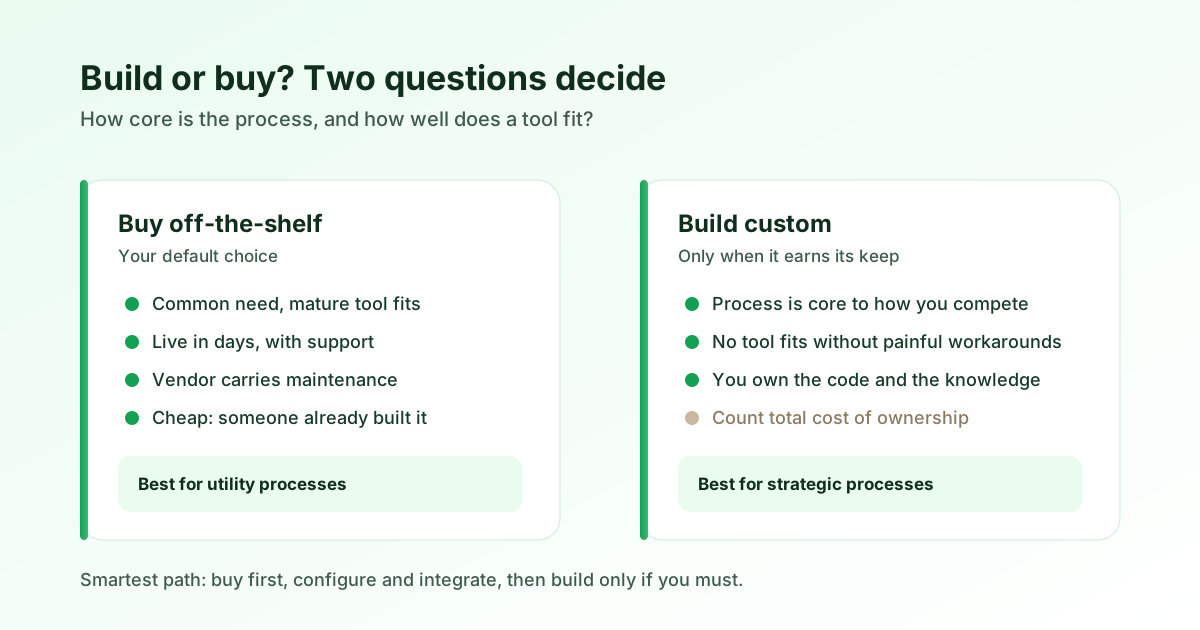
The build vs buy decision comes down to two questions: is this process core to how you compete, and does an off-the-shelf tool actually fit it? Buy when the need is common and a mature tool fits well, because building would just reinvent something you can rent cheaply. Build a custom internal tool when the process is genuinely core, no existing tool fits without painful workarounds, and the value clearly beats the true cost of building and maintaining it over time. Most businesses should buy far more than they build, and the expensive mistakes come from building too early or for the wrong reasons.
This guide covers when off-the-shelf is right, when custom actually pays off, the real cost of building, and how to decide without overspending or locking yourself into the wrong tool.
Key takeaways
- Build vs buy hinges on two things: how core the process is, and how well a tool fits.
- Buy for common needs a mature tool handles. Build only for core processes nothing fits.
- The real cost of building includes maintenance, changes and hosting for years, not just version one.
- Starting by buying and building later is usually the smart, lower-risk path.
- Custom is a strategic tool for where you compete, not a status symbol or a first resort.
The two questions that decide it
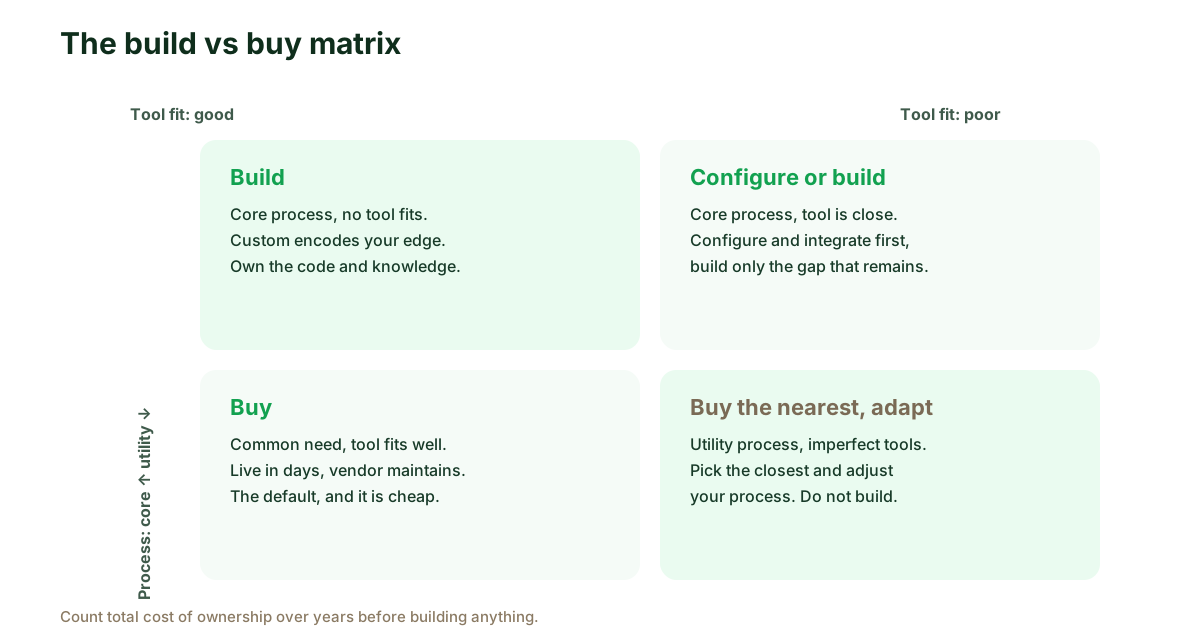
Strip away the noise and the decision rests on two axes. First, how core is this process to how you actually compete and operate? A process that is central to your differentiation is a candidate for custom; a generic back-office need almost never is. Second, how well does an existing tool fit? If a mature off-the-shelf product does the job well, buying is nearly always right; if every tool forces painful workarounds that cost real time, custom starts to make sense.
Plot your need on those two axes and the answer usually appears. Common process plus good tool fit means buy, every time. Core process plus poor fit is where building earns its keep. This maps closely to a well-known idea in software strategy, Martin Fowler’s utility versus strategic dichotomy: build the software that is strategic to your business, and buy or rent the software that is mere utility. Our custom platform work starts with exactly this diagnosis, because building the wrong thing is the most expensive outcome of all.
When to buy off-the-shelf
Buying should be your default, and here is when it is clearly right. When the need is common, accounting, CRM, email, scheduling, most marketing tools, mature products already do it well, cheaply, and with support, so building would only reinvent the wheel at your expense. When a tool fits your process closely enough that any gaps are minor, buy it and adapt slightly rather than build. When you need it working now, off-the-shelf is live in days, not months. And when you do not have the appetite to maintain software forever, buying hands that burden to the vendor.
The strong bias toward buying exists for good reason: someone else has already spent years and millions building and hardening that tool, and you get it for a subscription. Reserve building for the rare cases where that trade genuinely does not work, and you will avoid the most common and costly software mistake, building what you could have bought.
When to build a custom internal tool
Building earns its place in specific situations. When a process is genuinely core to how you compete and no tool captures the way you do it, custom lets you encode your actual advantage instead of bending it to fit generic software. When the workarounds around existing tools, the spreadsheets bridging systems, the manual copy-paste between apps, the steps no tool supports, are costing real time and money every week, a purpose-built tool can remove that cost. When you are stitching several tools together clumsily and a single custom tool would replace the mess. And when you genuinely will own and maintain what you build, so it stays useful.
In these cases custom is not indulgence, it is leverage: a tool shaped exactly to your business that removes friction generic software cannot. This is the kind of internal tool or custom platform that pays for itself by eliminating ongoing waste or unlocking something competitors using only off-the-shelf tools cannot match. The same build-versus-buy judgement applies to whether you build capability in-house at all, which we cover for data analytics.
The real cost of building (that people forget)
The biggest mistake in build-vs-buy is comparing the price of buying to only the price of building version one. That is not the real comparison. The true cost of custom software is its total cost of ownership over years: the initial build, plus ongoing maintenance, hosting, bug fixes, security updates, and the continuous changes needed as your business evolves. Software is never finished; it needs care for as long as you use it.
There is also a hidden risk cost: if the knowledge of how your custom tool works lives with one developer or one vendor, you are exposed when they leave. A mature bought tool spreads that risk across the vendor’s whole company; a custom tool concentrates it. None of this means do not build, it means count the real cost honestly. When you do, some things that looked worth building turn out not to be, and the ones that survive the honest maths are the ones genuinely worth it. Frameworks like the ThoughtWorks Technology Radar exist precisely to help teams weigh these long-term trade-offs rather than chase novelty.
The smartest path: buy first, build later
For most businesses the lowest-risk route is not a pure build-or-buy choice at all, but a sequence: buy first to prove the need and learn, then build later only if you outgrow the tool. Starting with an off-the-shelf product lets you validate that the process matters, discover what you actually require, and get value immediately, all before committing to the cost and risk of custom software. Then, if and only if you hit a real constraint the tool cannot solve, you build, and you build the right thing because you now understand the problem deeply.
Building too early is one of the most expensive mistakes in software, because you commit to a custom solution before you truly understand the need, and often build the wrong thing. Buying first turns that risk into cheap learning. The exception is when the process is so obviously core and so poorly served by any tool that building is clearly right from day one, but that is rarer than founders think. When in doubt, buy, learn, and let real constraints, not enthusiasm, trigger the build.
Configure and integrate before you build
There is a valuable middle ground that many businesses skip straight past on their way to building: configuring and integrating the tools they already have. Modern off-the-shelf tools are often highly configurable, and a lot of “we need custom software” is really “we have not set up our existing tools properly or connected them together.” Before commissioning a build, ask whether configuration, a well-chosen integration, or a light automation layer between existing tools would solve the problem. Often it will, at a fraction of the cost, and this is exactly where marketing automation and workflow tools shine, gluing systems together without a full custom build. Reserve true custom development for what genuinely cannot be achieved by configuring and connecting what already exists, and you will spend far less while getting most of the benefit.
Signs you have genuinely outgrown off-the-shelf
Because building too early is the classic error, it helps to know the honest signals that you have actually outgrown a bought tool, rather than just being frustrated with it. The clearest sign is recurring, expensive workarounds: your team spends real hours every week bridging what the tool cannot do, with spreadsheets, manual re-entry, or steps done outside the system. Another is that the tool forces you to change a genuinely core process in a way that costs you your edge, not just your comfort. A third is that you are paying for and stitching together several tools to cover one workflow, and the seams keep breaking. A fourth is scale: volumes or rules the tool was never built for, where every month of workaround costs more than a purpose-built tool would.
Notice what is not on that list: the tool being mildly annoying, missing a nice-to-have feature, or not looking exactly how you would like. Those are reasons to configure or adapt, not to build. Reserve the build decision for constraints that cost real, ongoing money or genuinely block how you compete, and you will build rarely and build well.
A quick worked example
Imagine a distributor running order management across a spreadsheet, a WhatsApp group and an accounting tool, with a person manually copying data between all three for hours a day. Is this a build case? Test it. Is order management core? Fairly. Does a tool fit? Maybe an off-the-shelf order tool would cover most of it, so buy and trial that first. If, after trying, the specific way they handle pricing and dispatch genuinely cannot be captured by any tool, and the manual bridging is still costing hours daily, then a custom internal tool that removes that ongoing cost is clearly justified, and the maths is easy: the hours saved every week quickly exceed the build plus maintenance cost. That is a real build case, reached by evidence rather than enthusiasm.
How to decide, in practice
Put your need through a short sequence. First, can you buy a mature tool that fits well? If yes, buy it. If not, can you make an existing tool fit through configuration or a simple integration? If yes, do that. Only if both fail, and the process is genuinely core, does building become the answer, and even then, count the total cost of ownership over years before committing, and make sure you own the code and the knowledge. This order, buy, then configure and integrate, then build, protects you from the two big mistakes: paying to build what you could have bought, and forcing a core, ill-fitting process through generic software forever. Follow it and you spend money only where custom truly earns its keep.
Where to start
If you are unsure whether you should buy, configure, or build, the worst move is to guess and commit to an expensive build. Our free audit looks at the process you are trying to solve and tells you honestly whether an off-the-shelf tool, a smart integration, or a custom build is the right answer, before you spend on development. From there, if building genuinely is right, our custom platform work scopes it properly and builds something you own, as part of the broader Automate work that removes real cost from how your business runs.
Frequently asked questions
Build when the process is core to how you compete and no off-the-shelf tool fits it well, when the workarounds around existing tools are costing real time or money, and when you will own and maintain what you build. Buy when the need is common, a mature tool fits, and building would just reinvent something you can rent cheaply.
It is worth it when the tool removes a genuine, ongoing cost or unlocks something a generic tool cannot, and when that value clearly exceeds the build plus maintenance cost over time. It is not worth it for common needs that off-the-shelf tools already handle well, where building just adds cost and maintenance for no real edge.
More than the initial build. The true cost includes ongoing maintenance, hosting, fixes, changes as your business evolves, and the risk of the knowledge living with one person. A realistic build-vs-buy decision counts total cost of ownership over years, not just the price of version one.
Often yes, and it is usually the sensible path. Start with an off-the-shelf tool to prove the need and learn what you actually require, then build custom only if you outgrow it or the fit becomes a real constraint. Building too early, before you understand the problem, is a common and expensive mistake.
Want this done for you?
Yovance is an AI growth and automation studio. We can put this into practice for your business.