Do webinars still work for B2B lead generation in 2026?
Do webinars still work for B2B lead generation? Yes, when run as a system: the right topic, a real funnel, follow-up and an evergreen replay. Here is how.
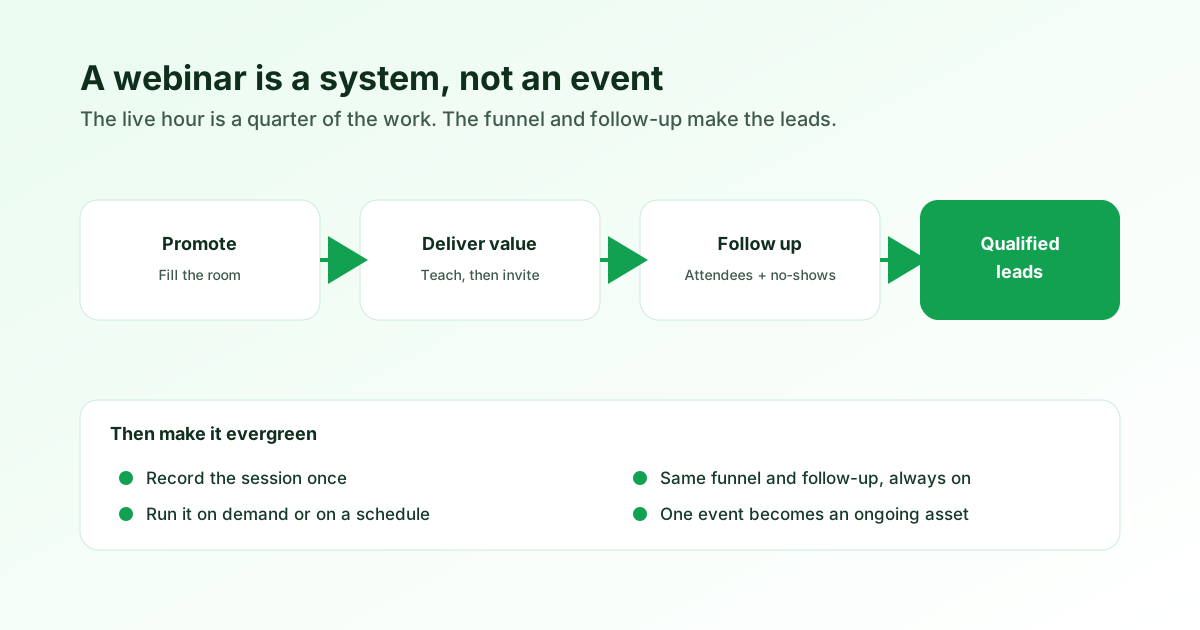
Do webinars still work for B2B lead generation? Yes, but only when you run them as a system, not a one-off event. A webinar gives you three things almost nothing else does: a qualified audience that raised their hand on a specific topic, a full hour of their attention, and a natural reason to follow up. The businesses that say webinars are dead almost always ran the event and skipped the funnel and follow-up around it, which is exactly where the leads are made. Get the whole system right and a webinar is one of the highest-intent lead sources in B2B.
This guide covers why webinars still work, the four parts of a webinar that actually generates leads, how evergreen replays turn one event into an ongoing asset, and the mistakes that make people think webinars have stopped working.
Key takeaways
- Webinars still work, but as a system: topic, funnel, session, and follow-up, not just an event.
- The live hour is roughly a quarter of the work. The funnel and follow-up create the leads.
- B2B webinar leads are highly qualified, so judge on pipeline and revenue, not attendance.
- An evergreen replay turns a one-time webinar into an asset that generates leads continuously.
- Most “webinars are dead” verdicts come from skipping promotion and follow-up, not from the format.
Why webinars still work for B2B
A webinar is unusually well suited to B2B because of what it gives you. When someone registers, they have told you they care about a specific problem, that is qualification you did not have to guess at. When they attend, they give you something scarce and valuable: an hour of focused attention, which no ad or email ever gets. And the event itself creates a natural, welcome reason to follow up, because you have just spent real time being useful to them. That combination, self-selected intent plus deep attention plus a reason to talk, is rare and powerful.
This is why webinars have not been killed by shorter formats; they do a different job. Industry research on content, including the Content Marketing Institute’s ongoing research, consistently ranks webinars among the formats B2B marketers rate as most effective for generating and converting demand. The format works; the execution is where businesses succeed or fail. It is one of the durable owned channels we cover in getting more B2B leads without more ad spend, and it is the whole basis of our webinar engine work.
The four parts of a webinar that generates leads
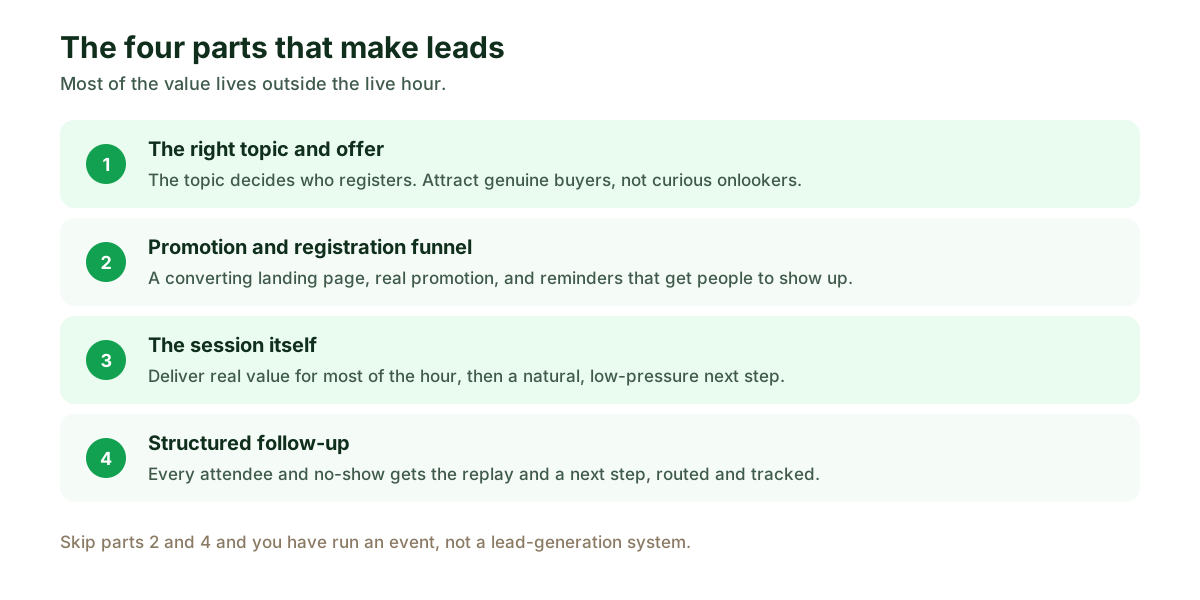
The event people picture is only one piece. A webinar that actually generates leads has four parts, and most of the value lives outside the live hour.
- The right topic and offer. The topic decides who registers, so it must attract genuine buyers, not just curious onlookers. Frame it around a real, valuable problem your ideal customer has, narrow enough to be compelling and close enough to what you do that attendees are natural prospects.
- The promotion and registration funnel. A great webinar to an empty room generates nothing. You need a landing page that converts, a promotion plan across email, social and your founder brand, and reminders that actually get people to show up. This is where volume comes from.
- The session itself. Deliver real value for most of the hour, teach something genuinely useful, then make a natural, low-pressure transition to a next step. Give first; the offer earns its place only after the value lands.
- The follow-up. The single most neglected part, and the one that makes or breaks results. Every attendee and, crucially, every no-show should get structured follow-up: the replay, a summary, and a clear next step, routed and tracked like any other lead.
Notice that the live hour is roughly a quarter of the work. Businesses that only do the event, and skip the funnel and follow-up, capture a fraction of the value and then conclude webinars do not work.
The follow-up is where the leads actually are
It is worth dwelling on follow-up, because it is where most webinar value leaks away. Two groups matter. Attendees showed high intent by turning up, so they deserve prompt, personalised follow-up while the session is fresh: the replay, key resources, and an easy way to talk. No-shows registered, which means they were interested but life got in the way; they are not lost, and a good replay-and-follow-up sequence often converts as many leads from no-shows as from attendees.
Doing this by hand across dozens or hundreds of registrants is where it falls apart, which is why follow-up should be automated and tracked. Every registrant flows into your CRM, gets the right sequence based on whether they attended, and no warm lead is forgotten. This is the same discipline as automating lead follow-up, applied to a webinar, and it is delivered through marketing automation. Without it, you have run an event; with it, you have run a lead-generation system.
Evergreen webinars: one event, ongoing leads
The economics of webinars get genuinely attractive once you stop treating them as one-time events. An evergreen webinar is a recorded session set up to run on demand or on a schedule, so people can register and watch any time and the whole funnel, registration, session, follow-up, keeps running without you being live again. One strong live webinar becomes a permanent asset that generates registrations and leads month after month.
This is the difference between a webinar as an event and a webinar as an engine. You do the hard work once, producing a genuinely valuable session and a funnel that converts, and then it compounds, much like content and SEO do. The best approach for many businesses is a small number of excellent evergreen webinars on their core topics, promoted continuously, supplemented by the occasional live event for freshness and urgency. Reputable webinar benchmarks, such as those published by platforms like ON24, show that on-demand and evergreen viewing now makes up a large and growing share of webinar engagement, which is exactly why building for evergreen pays off.
How to pick a topic that fills the room
The topic is the highest-leverage decision, because it determines both who registers and how qualified they are, so it is worth getting right before anything else. Aim for the overlap between three things: a problem your ideal buyer genuinely worries about, a subject you can speak on with real authority, and an angle close enough to what you sell that attendees are natural prospects. A topic too broad (“digital marketing trends”) pulls a big, unqualified crowd that never buys; a topic too narrow or too obviously a product demo pulls almost no one. The sweet spot is a specific, valuable problem framed as an outcome the buyer wants.
A simple test: would your ideal customer give up an hour of a busy workday for this, and would solving this problem make them more likely to need you? If both are yes, you have a topic. Reuse the same buyer questions that make strong blog and search content, because a question worth ranking for is usually a question worth running a webinar on, and the two channels then reinforce each other.
Webinars versus other B2B formats
It helps to be clear on where webinars fit rather than treating every format as competing. Short-form content and social build awareness and trust at the top; search and AI search capture active demand; a founder brand builds relationships over time. Webinars do something the others cannot: they secure a block of deep, live attention from people who self-selected on a specific problem, which is why they sit lower in the funnel and convert so well. They are not a replacement for your other channels; they are the high-intent moment those channels can feed into. In practice, your content and founder brand fill webinar registrations, and the webinar then produces sales-ready conversations, so the layers compound rather than compete. Seen this way, the question is never webinars versus content or ads, but how webinars slot into a system where every channel makes the others work harder.
The mistakes that make people say webinars are dead
Almost every “webinars do not work” verdict traces back to one of these. The first is no promotion: building a great session and then barely marketing it, so the room is empty. The second is a weak topic: something too broad or too self-promotional that attracts no real buyers. The third is pitching too early or too hard, so attendees feel sold to rather than helped and tune out. The fourth, and biggest, is no follow-up: running the event and then doing nothing with the registrants, which throws away most of the value. The fifth is judging success by attendance rather than pipeline, so a small, highly qualified room gets written off as a failure when it may have produced excellent leads.
Fix these and the format works as well as it ever did. The webinar itself was rarely the problem; the system around it was missing.
How to measure a webinar honestly
Because webinar leads are so qualified, measuring by attendance alone is misleading. Track the full funnel: registrations, attendance rate, engagement during the session, and, most importantly, the qualified leads and pipeline that follow, including from no-shows via the replay. A webinar with modest attendance that produces a handful of serious, sales-ready conversations can easily beat a big-audience session that generated nothing but vanity numbers. Judge webinars the way you should judge any channel, on qualified pipeline and revenue, which is exactly the buyer-focused measurement that good decision intelligence brings to every marketing decision. Measured this way, webinars often reveal themselves as one of your highest-return channels, precisely because the people who give you an hour are the people most likely to buy. It also pays to look at cost per qualified lead rather than cost per registration: an evergreen webinar that keeps producing serious conversations for months has a cost per qualified lead that keeps falling long after the work is done, which is a very different economic picture from a single live event judged on the day.
Where to start
If you have tried a webinar and it fell flat, the format is probably not the problem, the system around it is. Our free audit looks at how you generate and convert demand and shows whether a properly built webinar engine would be one of your highest-return channels, before you commit to producing one. From there, our webinar engine work builds the whole system, topic, funnel, session support, follow-up and an evergreen replay, as part of the broader Grow engine that creates durable, owned demand.
Frequently asked questions
Yes, when run as a system rather than a one-off event. A webinar gives you a qualified audience that raised their hand on a specific topic, an hour of their attention, and a natural reason to follow up. The businesses for whom webinars fail almost always skip the funnel and the follow-up and just run the event, which is where most of the value actually is.
Four things: a topic that attracts genuine buyers, a promotion and registration funnel that fills the room, a session that delivers real value with a natural next step, and structured follow-up for both attendees and no-shows. The live hour is only a quarter of the work; the funnel and follow-up around it are where leads are made.
An evergreen webinar is a recorded session set up to run on demand or on a schedule, so it keeps generating registrations and leads long after the live event. It turns a one-time effort into an asset that works continuously, which is what makes the economics of webinars genuinely attractive.
Fewer than you think, because B2B webinar leads are highly qualified. A modest room of the right people who chose to spend an hour on your topic can be worth far more than thousands of cold impressions. Judge a webinar on qualified pipeline and revenue, not on attendance numbers.
Want this done for you?
Yovance is an AI growth and automation studio. We can put this into practice for your business.